
Spotlight: Rural Task Force
Main article content
FORCEWIDE
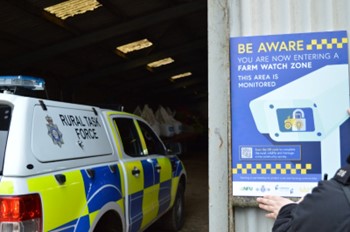
Most would just assume our Rural Task Force are out patrolling the countryside, where it’s quiet and not much happens – but how wrong could we be?
We spoke to Rural Task Force Sergeant Kevin Jones recently to find out what the team had been up to in order to tackle Serious Acquisitive Rural Crime.
What’s Serious Acquisitive Rural Crime?
Serious Acquisitive Crime (SAC) for short is a term used to describe organised serious theft or burglary’s where the impact has large financial and economic consequences to its victims, industry, and the UK as a whole such as theft of plant and agricultural machinery. The NFU Mutual Rural Crime Report 2024 has estimated the cost of Rural Theft to the UK economy has been £52.8m in 2023.
The Theft of Plant and Agricultural Machinery is a significant issue with millions of pounds worth of equipment stolen every year by criminals who seek to gain significant profit by the theft and sale of these machines and equipment.
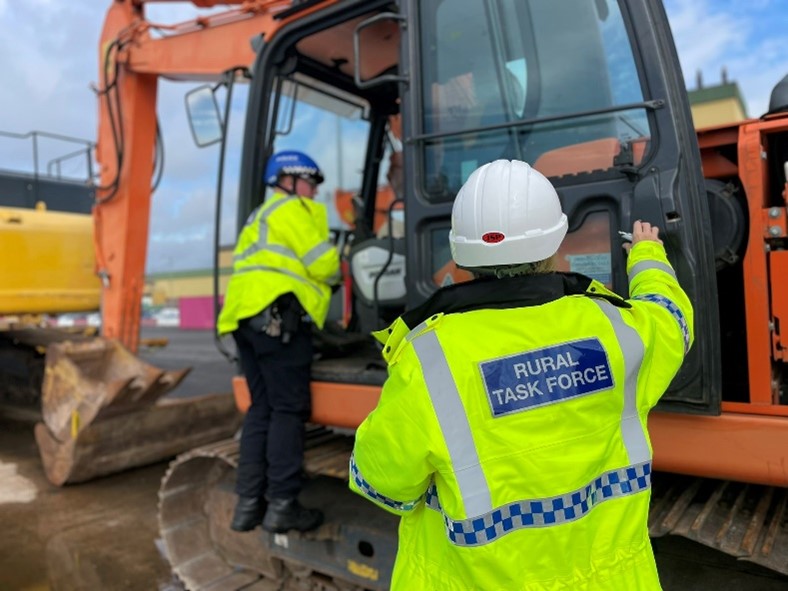
We can see how this fits into our overall Kinetic Strategy - to relentlessly disrupt OCGs and protect our community. How do you do this?
This is one of our main areas of work that fits with our commitment to the Kinetic strategy as we target OCGs (Organised Crime Groups) stealing high value plant and agricultural machinery leaving the UK to be exported illegally abroad.
The criminality involved are members of OCGs who recognise the vulnerabilities in the sectors that Plant and Agricultural Machinery operate including remote farms. There is a difficulty securing these high value assets and they are used day and night – criminals will seek to exploit this – with machines being transported in plain sight, very easily, with intentions to get to the ports and to export quickly to make profits.
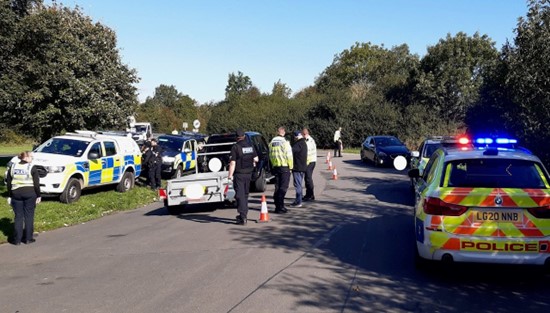
Our response to Serious Acquisitive Rural Crime consists of multi-agency roadside check point days which involve proactive vehicle stop checks on vehicles towing trailers, plant, and agricultural machinery for any stolen markers.
We also work closely with sharing information amongst our colleagues within Border Force and regularly attending the Port Networks for routine checks on plant and agricultural machinery destined for Europe and overseas.
It’s not just about pursuing criminals, it’s also about measures that can be put in place to prevent the emotional and financial impact on victims of rural crime too.
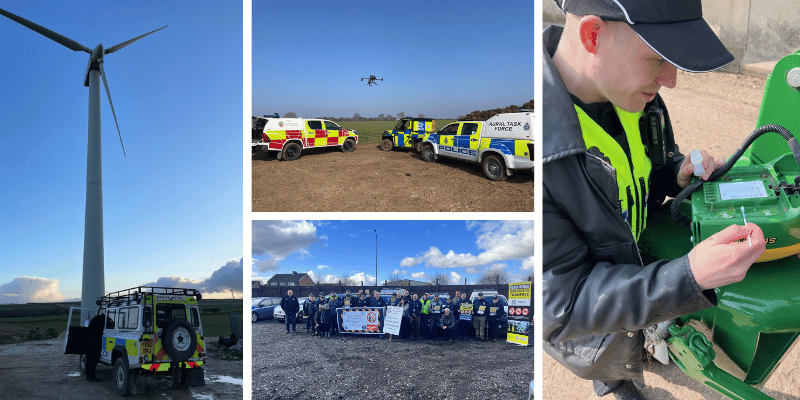
For these reasons we continue to provide enhanced Rural Crime Prevention visits to farms across the Humberside area, rolling out forensic marking solutions including SelectaDNA and Datatag to deter theft and assist with the identification of stolen property, or return it to the rightful owner.
All the staff involved put in an amazing amount of hard work and effort, during roadside checks in some challenging weather conditions – everyone’s level of enthusiasm and focus to the task demonstrates a professional work ethic and partnership approach.
Can you share with us some of the good results from your roadside check point days?
Sure. Last year, we conducted several multi-agency roadside check point days being joined by the National Caravan Council, National Construction and Agricultural Theft Team, Data tag Vehicle Examiners and East Riding of Yorkshire Council Waste Carrier Licence Team.
Routine checks on caravans, trailers, plant, and commercial vehicles were conducted to check for stolen markers or intelligence linked to OCGs/SAC.
During our latest roadside check point day – 32 vehicles were checked with one arrest, one drug seizure, and traffic offences dealt with.
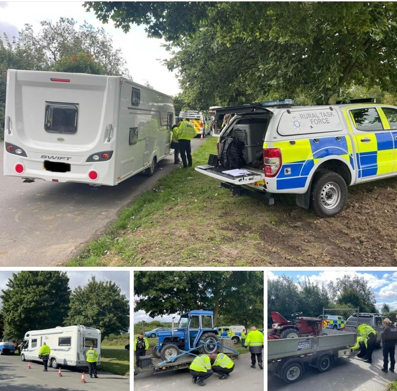
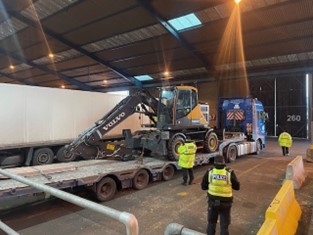
During our latest check point day at one of our Port Networks we did 73 checks completed on plant, agricultural machinery and commercial vehicles and freight. We also carried out 61 accompanied vehicle and driver checks, including checking 23 passengers and a further 12 unaccompanied vehicle checks.
We also detained 35 vehicles for searching, and we found one traffic offence where a vehicle had no insurance, so it was detained on the port.
We disrupted finance fraud on a Note boom low loader trailer too, which was due to be shipped overseas and our checks showed it as having outstanding finances. This hadn’t arrived on the dockside at the time, so the Border Force were made aware, and they were ready for a hold to be placed on trailer to prevent it being exported.
We found one tyre and suspension prohibition, one fuel cap/engine malfunction prohibition, and two drivers had exceeded their four-and-a-half-hour drive with no breaks resulting in a £600 fine. We also issued three verbal warning offences for rest breaks – prompting road safety and responsible driving hours.
This proactive work is at the more unusual end of the scale of what we do in the Rural Task Force and is good to share across the county. We want to disrupt the OCGs who steal millions of pounds worth of machinery every year.
Op Shield is back again this March for another intensification period, what are the Rural Task Force up to as part of this operation?
We have ben supporting the likes of Op Yellowfin with their proactive activity around tackling criminality and anti social behaviour.
Off-road motorbikes are a real concern for a lot of the farming community as riders tend to ride across farmland especially in Bridlington which causes crop damage, criminal damage, and financial impact on landowners, not to mention the emotional impact this subsequently has on farmers and landowners.
We work collaboratively with local Neighbourhood Policing Teams, utilising the drone provided by Humberside Fire and Rescue Services, and also Farm Watch to support in detaining individuals and recovering bikes without putting members of the public at risk.
We do this by being the eyes in the skies for officers on the ground, and also utilising our all-terrain vehicles (our 4x4s and Polaris) to help gather information and a bigger picture around those offending to enable Op Shield officers on the ground to disrupt, detain, and hold them responsible for their actions.
Crimes of this nature are extremely disruptive for local residents and communities, with riders showing complete disregard for the safety of other road users and pedestrians by riding anti socially both on roads and footpaths.
A lot of our Op Shield activity has focused around partnership working and engaging with community groups, as well as offering crime prevention advice to help landowners and farmers keep their assets as safe and secure as possible from installing CCTV cameras and perimeter fencing, to forensic marking, deterrent signing, and more.
We also work closely with our force Designing Out Crime Officers from the Crime Reduction Unit who assists us with offering crime prevention advice, and looking at how we can 'design out crime' amongst the farming community. You can find out more about what the team do and exactly 'designing out crime' means, click here.
What do you love about working in the Rural Task Force?
I love that we get to do these more unusual operations and that most members of the public wouldn’t necessarily associate us with. I talk to a lot of other officers and members of the public, and it’s a common myth that we just patrol the countryside, helping remove stray sheep off the roads. We are so much more than that.
We have our own strategy for forensic marking of high value machines and with regards to the theft of GPS devices we have the largest recovery of these too.
I’m proud of the team I work with. We are always trying to evolve our tactics to recover stolen property and stay ahead of the criminals. This is one of our biggest challenges.